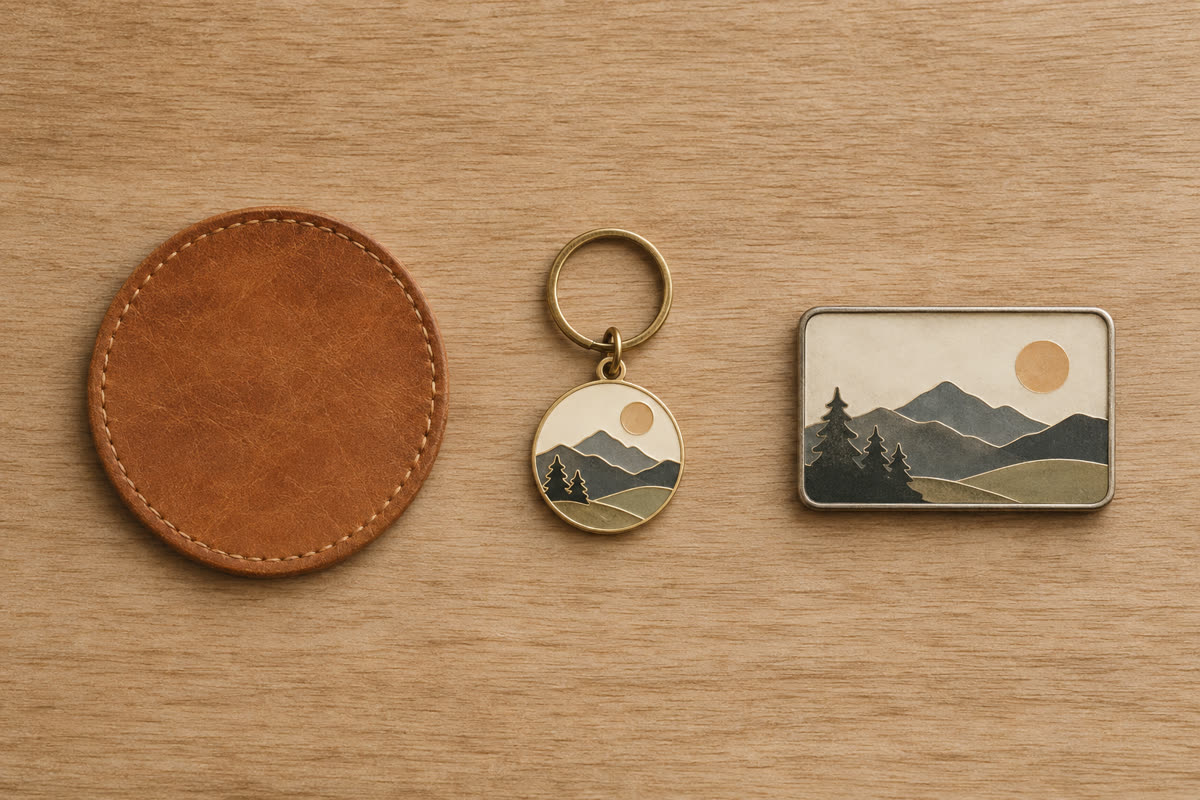
If you have a small budget and want one item that keeps working after the guest leaves, you are choosing between three things: a coaster, a fridge magnet, or a keychain. All three are cheap. All three leave the building. They behave very differently once they get home.
We make all three, which means we have no particular interest in which one you choose — but we do have a view on when each one is the right answer.
Retention: how long it stays
Fridge magnets win, and it is not close. A magnet goes onto a fridge and stays there for years. It is not cleaned, not put away, not moved. It is seen by everyone in the household, every day, including people who will never stay with you. In retention terms, it is the most efficient object a hotel can give away.
Keychains come second. Once a keychain is on a set of keys it stays for years and gets handled several times a day. The catch is that it has to earn its place — a guest who already has a keyring will not swap it for a promotional one. Retention is high but conditional.
Coasters are the weakest of the three on paper. A coaster has to survive the trip home and then find a use. Many do; plenty do not. Retention is shorter and much more variable, and it depends almost entirely on material — a leather coaster gets picked up, a card coaster does not.
Visibility: who sees it
This is where the ranking changes.
A keychain is the most portable of the three. It goes outside, into shops, onto tables, into the hands of whoever is holding the keys. It is the only one of the three that gets seen by strangers.
A magnet is the least portable and the most domestic. It never leaves the kitchen, but it is seen by a small group of people with high frequency. If your goal is household penetration, this is the one.
A coaster sits in between. It lives on a desk or a coffee table, which means it is seen by guests, colleagues, and anyone who visits — a wider circle than the fridge, narrower than the street.
Frequency: how often it is noticed
Per day, roughly:
- Keychain: handled 3–8 times. Seen by the owner constantly, by others occasionally.
- Coaster: seen 1–5 times, depending on how much coffee the household drinks.
- Magnet: seen 1–3 times, but by more people at once.
These numbers are rough, but the ordering holds. A keychain is the most touched; a magnet is the most shared; a coaster is somewhere in the middle and depends on whether it found a home.
Cost per impression
Putting the three side by side at typical unit costs:
| Item | Unit cost | Typical lifetime impressions | Cost per 1,000 |
|---|---|---|---|
| Fridge magnet | $0.32 | 600–1,000 | ~$0.40 |
| Keychain | $0.68 | 500–700 | ~$1.10 |
| Coaster (leather) | $0.65 | 250–450 | ~$1.85 |
The magnet is the clear winner on pure efficiency, by a factor of three. That is worth sitting with for a moment, because it is not intuitive: the cheapest object is also the most effective one per dollar.
So why would you choose anything else?
Because cost per impression is not the only thing a hotel is buying.
Coasters buy perceived quality. A leather or stone coaster in a room reads as a considered detail. It is the kind of object that makes a desk feel finished. The magnet does not do that, because it is not in the room — it is in the kitchen.
Keychains buy hand-time. If your property has a signature that benefits from being held — a distinctive shape, an engraved logo — a keychain puts it in a hand several times a day. A magnet never gets handled.
Magnets buy reach. If the goal is for your name to be present in as many homes as possible for as long as possible, nothing else comes close at the price.
A practical way to choose
Ask what you want the item to do, then pick the one that does that job.
- Maximise homes reached: magnet.
- Maximise time in hand: keychain.
- Improve the room itself: coaster.
- Do all three on a small budget: run a magnet as the take-home item and a coaster as the in-room detail. They are not competing — one works inside the property, one works outside it.
That last combination is what most of our hotel clients end up with, and it usually costs less than a single heavier item would.
Why the three work better together
The instinct when budgets are tight is to pick one item and buy more of it. That is usually the wrong move, because the three objects do different jobs and the jobs do not overlap.
A magnet reaches households you will never visit. A keychain puts your mark in a hand several times a day. A coaster improves the room the guest is standing in right now, which is the only one of the three that affects how the stay feels.
A property running all three spends more per room than one running a single item, but the marginal cost of the second and third categories is small — and the combined effect is a room that feels considered, a bag that leaves with something in it, and a fridge somewhere with your name on it.
If you have to choose two, take the magnet and the coaster. One works outside the building, one works inside it, and between them they cover the whole stay.
The material caveat
None of this works if the object feels disposable. A 6-gram keychain gets binned. A card coaster gets left on the desk. A flexible magnet with a thin print curls at the corner and gets thrown away within a month.
In all three categories, the difference between an item that works and one that does not is measured in grams and millimetres, not in the print. If a quote is dramatically cheaper than the others, that is usually where the difference lives.
All three are in our guest room range, with the exposure profile of each. If you want to price a combination for your room count, the basket builder will total it.