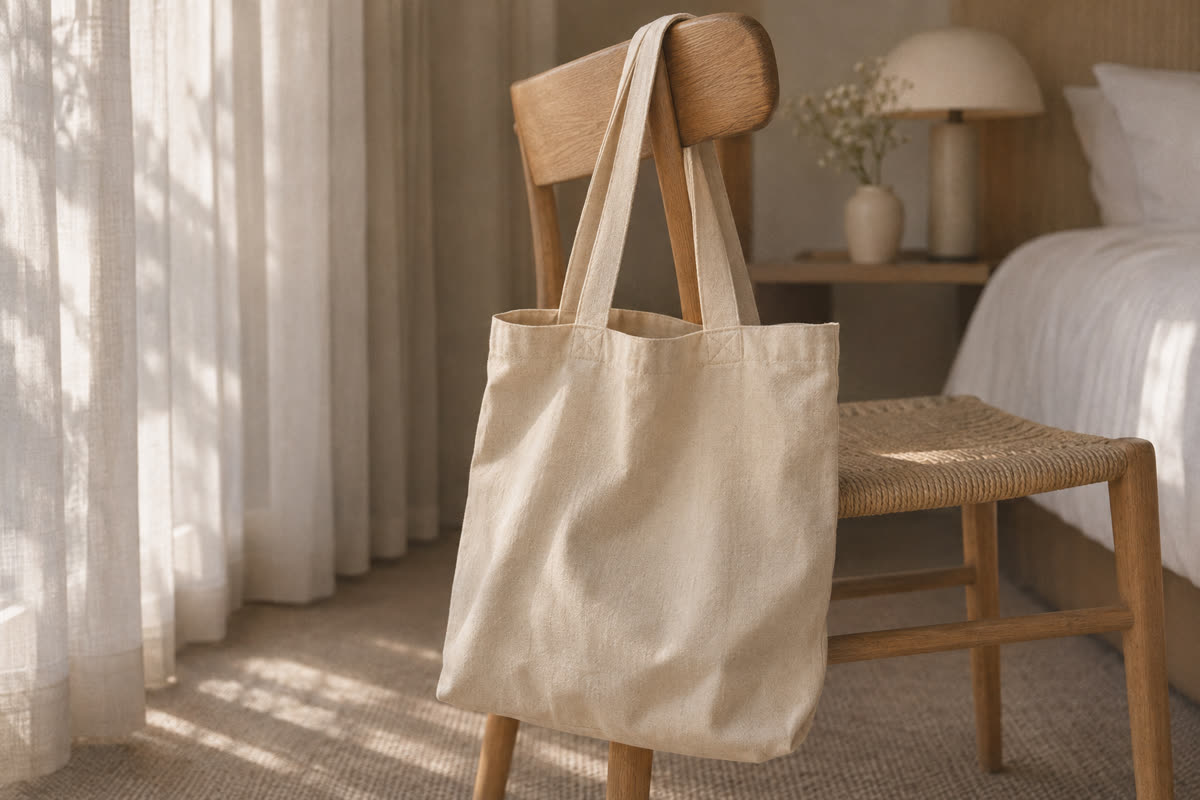
A tote bag is the only item in a hotel room that can advertise you to strangers on a street. It is also the item most likely to be thrown away within a week.
The difference between those two outcomes is almost never the design. It is three construction details that most buyers never ask about, because they are not visible on a quote.
Detail one: the handle attachment
This is where cheap bags fail first. A handle stitched onto the top hem with a single row of stitching will start to pull within a month of normal use. Once one side goes, the bag is finished.
What to specify: handles stitched into the body seam, or attached with a box-X stitch and a reinforcement patch. It costs a few cents more per bag and it is the single biggest predictor of whether the bag survives.
If you are comparing quotes, ask for a photo of the handle attachment on the actual production sample. It is the fastest way to tell a $0.90 bag from a $1.25 bag.
Detail two: fabric weight
Most promotional totes use 80–100 gsm non-woven polypropylene. It is inexpensive, it prints well, and it tears at the handle within weeks.
For a bag that gets reused, the useful range is:
- 210T ripstop nylon: light, packs into its own pocket, holds 8–10kg. Good for a bag that lives in a handbag.
- 10oz cotton canvas: heavy, structured, holds its shape. Good for a bag that gets used for shopping.
- 12oz canvas: the premium option. Feels like a retail product rather than a giveaway.
The trade-off is freight. Canvas is heavy, and a container of canvas bags costs more to move than a container of nylon. For long-haul shipping, ripstop is often the better economic choice even at a similar unit price.
Detail three: whether it folds
A bag that folds into its own pocket gets carried. A bag that does not gets left in the wardrobe.
This sounds like a small feature. In practice it changes the entire use case: a folding bag lives in a handbag or a glovebox and comes out when needed, which means it is used weekly rather than once. A non-folding canvas tote gets used for the beach and then forgotten.
If your property serves guests who walk, shop, or take public transport, the folding version will outperform. If you serve a resort where the bag goes from room to pool and back, a structured canvas tote is the better object.
The print question
Counter-intuitively, a large logo is not the goal. A tote bag with a full-bleed brand treatment reads as promotional and gets treated as such — used once, then relegated.
A small mark, well placed, reads as a product. Guests carry products. They do not carry advertising.
Two placements that work: a small mark at the base of one handle, or a single line of type across the lower third. Both survive being folded, and both look intentional rather than sponsored.
What it costs, and what it returns
A ripstop folding tote at 500 units typically lands between $1.10 and $1.40 per unit. A 10oz canvas tote is closer to $2.00–2.80. Both are more than a non-woven giveaway at $0.45.
The return calculation is not about the bag, it is about the number of times it is seen. A giveaway bag that gets binned after one use generates maybe 20 impressions. A canvas tote used weekly for two years, seen by perhaps 15 people per outing, generates several thousand.
Even at three times the unit cost, the better bag is cheaper per impression by an order of magnitude.
Where to put the logo, and how big
Print placement matters more than print size, and the instinct to go large is usually wrong.
Three placements that work:
- Base of one handle, 40–60mm wide. Reads as a maker's mark. Survives folding. The most discreet and the most effective.
- Lower third, centred, 80–120mm wide. The classic tote position. Works well with a single line of type.
- Inside the bag, on the base panel. A small mark the guest finds later. Unusual, and it tends to get mentioned.
What to avoid: full-bleed prints, all-over patterns, and anything that wraps the handle. All three read as promotional rather than retail, and all three shorten the bag's life because the print cracks along the fold lines.
On colour: a single-colour print on a natural canvas will outlast a four-colour print on the same fabric, because there is less ink to crack. If the bag is meant to last years, fewer colours is a durability decision as well as an aesthetic one.
Care, and how long it lasts
A canvas tote that gets washed once a month will last years; one that gets washed weekly will fade within a season. Worth telling guests, and worth printing on the care label if you are producing your own.
Ripstop is the easier fabric to live with — it wipes clean, does not shrink, and dries in minutes. Canvas is the better object but needs more care: cold wash, no tumble dryer, and it will soften and lighten over time, which most people find appealing and some do not.
The practical lifespan of a well-made tote in weekly use is three to five years. That is a long time for a marketing object, and it is why the construction details matter more than the print. A bag that survives becomes a permanent, quiet advert. A bag that fails becomes a reason not to trust the brand that gave it away.
Specifying an order
Five lines to include:
- Fabric and weight — 210T ripstop, 10oz canvas, 12oz canvas.
- Handle attachment — box-X stitch with reinforcement, or seam-stitched.
- Dimensions — flat or gusseted, and the finished size.
- Load rating — 8kg is a sensible minimum for a reusable bag.
- Print — method (screen print, heat transfer), colours, and placement.
Our tote bag range covers both the ripstop folding version and the canvas options, with load ratings on each. If you want to see what a mixed basket costs for your room count, the basket builder will total it.
The short version: the bag that gets reused is the one with a reinforced handle, enough weight to feel real, and a logo small enough to look like a product rather than an advert.